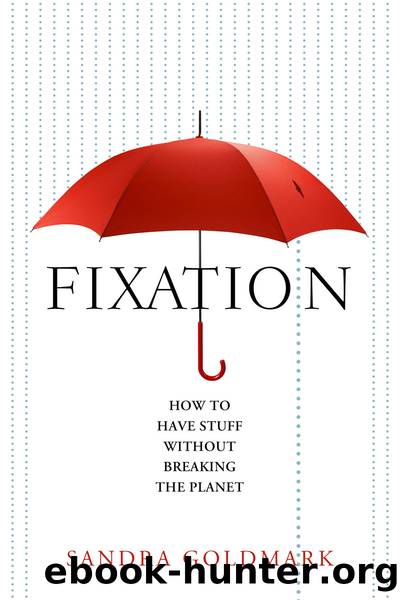
Fixation by Sandra Goldmark
Author:Sandra Goldmark
Language: eng
Format: epub
Publisher: Island Press
Published: 2020-11-15T00:00:00+00:00
Clothing, Couches, and the Challenges of âReverse Logisticsâ
Other barriers to buying used, however, are external, and removing them might make it more likely that people will change their personal habits. The main problems are logistical; itâs often simpler, today, to purchase a new sweater or chair or lamp than it is to purchase a used one. Online or in stores, you can choose from seemingly infinite options organized by style, color, price, brand. Vast amounts of human energy and ingenuity have been expended to make it astonishingly easy to make, market, transport, and sell you almost anything in a matter of days. The term âfrictionlessâ was coined to describe the ideal âuserâ (buyer) experience: never a hiccup or the hint of an obstacle to lessen the convenience for you, the customer, in opening your wallet.
In contrast, buying used is often still full of friction. Physical storefronts for new clothes vastly outnumber vintage shops. There are approximately twenty-five thousand thrift, resale, and consignment stores in the United States. (New York is home to just over 650 of them.)9 In comparison, there are five times that number of shopping malls in the countryâand that does not count individual storefronts.10 For the consumer, it takes effort to find used goods, especially âgoodâ used goodsâthough this challenge is actually getting easier, especially for clothing.
While new clothes are still prevalent, the resale market is growing twenty-one times faster than traditional retail. This resurgence of thrifting is in part a reaction to the rise of âfast fashion.â The term, coined in 1989, refers to the accelerated pace that the clothing industry developed to churn out more garments and increase sales. Some retailers can push a fast-fashion garment from the design phase to your closet in as little as a week.11 Fast fashion has grown remarkably over the past thirty years, and in 2018 represented a $35 billion market.12 The staggering environmental impact of producing all this new clothing has been well publicizedâas much as 1.2 billion tons of GHG emissions per year can be traced back to the apparel and textile industries, more than those of all international flights and maritime shipping combined.13
Partly as a backlash to this extreme situation, and partly because clothing reuse has a long and well-established history, the fashion industry is in many ways the most advanced in the âstuffâ world in terms of tackling reuse. Reuse in clothing is catching up, especially online. Clothing rental services such as Rent the Runway, closet-sharing services like Gwynnie Bee, used-clothing online retailers like ThredUP, and peer-to-peer platforms like Poshmark, are only a few of the players in this exploding industry.14 Despite these signs of change, itâs still more frictionless and much more common to buy new.
In terms of non-clothing items, the landscape of reuse is even more imbalanced. I can order a new lampâor ten thousand of themâonline in the blink of an eye. Ordering a used lamp is more complicated. One of the main reasons for this disparity is the challenge of âreverse logistics.
Download
This site does not store any files on its server. We only index and link to content provided by other sites. Please contact the content providers to delete copyright contents if any and email us, we'll remove relevant links or contents immediately.
The Brazilian Economy since the Great Financial Crisis of 20072008 by Philip Arestis Carolina Troncoso Baltar & Daniela Magalhães Prates(352469)
International Integration of the Brazilian Economy by Elias C. Grivoyannis(111546)
The Art of Coaching by Elena Aguilar(53592)
Flexible Working by Dale Gemma;(23350)
How to Stop Living Paycheck to Paycheck by Avery Breyer(19829)
Thinking, Fast and Slow by Kahneman Daniel(12502)
The Acquirer's Multiple: How the Billionaire Contrarians of Deep Value Beat the Market by Tobias Carlisle(12422)
The Radium Girls by Kate Moore(12165)
The Art of Thinking Clearly by Rolf Dobelli(10690)
Hit Refresh by Satya Nadella(9239)
The Compound Effect by Darren Hardy(9137)
Tools of Titans by Timothy Ferriss(8571)
Atomic Habits: Tiny Changes, Remarkable Results by James Clear(8493)
Turbulence by E. J. Noyes(8183)
A Court of Wings and Ruin by Sarah J. Maas(8085)
Change Your Questions, Change Your Life by Marilee Adams(7915)
Nudge - Improving Decisions about Health, Wealth, and Happiness by Thaler Sunstein(7837)
How to Be a Bawse: A Guide to Conquering Life by Lilly Singh(7601)
Win Bigly by Scott Adams(7322)
